How to write a memoir comes down to choosing interesting parts of your life and telling them as a story, with real-life scenes and a reason why people want to read about you. If you’ve been wondering how to write your life story, the memoir writing tips below take you through it step by step, including the difference between a memoir and an autobiography, how to structure a memoir, how to write about family without falling out with them, and how long a memoir should be.
My examples come from my own book, Mysteries and Misadventures, where each fictional tale is accompanied by a Story Behind the Stories section revealing my true childhood memories that inspired it, and from memoirist Elise Anderson, who shares what writing her own life story taught her.
A school litter project at Wick Harbour taught me that a camera was the perfect excuse to be out of class. So, as a teenager, I was skiving one day in a harbour café with a friend, our pool cues in black cases, which we passed off as photography equipment.
Then, to my horror, my parents walked in. I told them I was waiting for Matthew, who’d gone to the camera shop, so they sat down to wait with me. I was sweating and close to confessing when my friend Christopher, who was meant to be skiving with us that day, chose that moment to walk past the window. I ran out and grabbed him. ‘You’re Matthew,’ I hissed. He played along perfectly and we finished our drinks and carried on our merry way.
I’ve written about that day twice. The fiction version, Masters of Disguise, moved it to Prestwick for Ayrshire Stories, the anthology of west coast tales I compiled with other writers. The true version went into Mysteries and Misadventures: Tales from the Highlands, the book that later earned me a home-cooked dinner from my primary 5 teacher. The memoir needed a confession, and that confession is the short answer to what makes a memoir work. You choose one true moment, tell it as a scene, own the part that makes you look daft, and let the reader see why it still matters to you enough to put in a book.
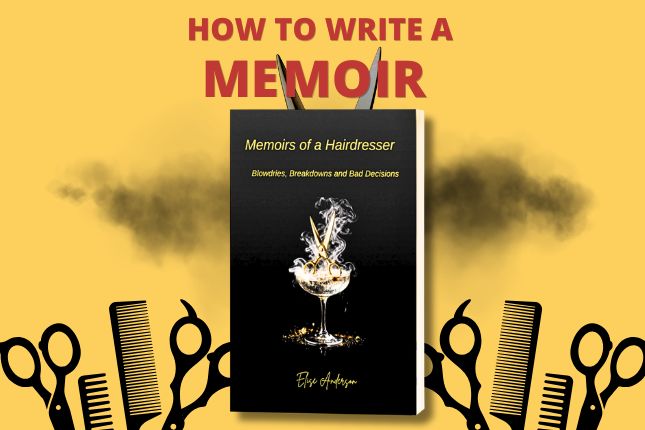
Maybe you’ve already typed ‘I was born’ and stalled there. A whole life won’t fit through one opening line, and it doesn’t need to. Below you’ll find eight steps, a psychologist’s fix for patchy memories, word counts, publishing routes and the hard questions about writing real people. Elise Anderson, author of Memoirs of a Hairdresser, adds what she learned writing hers. Elise’s memoir gathers what she calls ‘the funniest, most unhinged moments’ of her hairdressing career. Coincidentally, my own first full-time job, at 17, was as a barber in Northampton, and her trainee stories took me straight back to my first weeks with the clippers.
Memoir Writing Tips
- A memoir covers one slice of your life and an autobiography covers all of it, so choose your slice before you write a word.
- Start with the story you already tell best, and write it as a scene with a line of reflection after it.
- Memory rebuilds events each time you recall them, so check the facts and keep the emotional truth.
- Ask permission where you can, and cut any detail that only wounds people around you.
- Book-length memoirs usually run 60,000 to 90,000 words, but 5,000 words and a 300-word overview are enough to enter the Bridport Prize Memoir Award.

Article Contents
What’s the Difference Between a Memoir and an Autobiography?
The first thing to know about how to write a memoir is that a memoir covers one part of your life, while an autobiography covers all of it. A memoir follows one theme, period, place or relationship, such as a year at sea or a Highland childhood. An autobiography usually runs in date order, birth onwards.
The word itself gives you a clue. The Online Etymology Dictionary traces memoir to the Anglo-French memorie, a written note to help you remember, which reached English in the early 1400s.
You get one autobiography, but you can write several memoirs, one for each interesting part of your life. The Bridport Prize, which added a memoir award in 2022, defines a memoir as non-fiction about one period or set of experiences in the writer’s own life, and it won’t accept autobiographies.
Memoir sits inside creative non-fiction, which is true writing that borrows fiction’s tools, such as scenes and dialogue. A personal essay is the short form, one experience told in a few thousand words, and it’s a good place to start.
Can Anyone Learn How to Write a Memoir?
Anyone can learn how to write a memoir, and you don’t have to be famous to do so. Readers come for an honest story about a part of life they recognise, or one they’ve never seen, told in a voice they trust. If you can hold a friend’s attention with a true story, you already have the raw material.
Joanne Briggs had no plans to write a memoir until she saw the Bridport Prize advertising its new award. She began in October 2022 from a pile of notes and called her entry a 59th birthday present to herself. She won the inaugural award, judged by Cathy Rentzenbrink, and the literary agency A M Heath signed her, according to The Bookseller. Her memoir, The Scientist Who Wasn’t There, came out with Ithaka Press in June 2025.
How to Write a Memoir in 8 Steps
These eight memoir writing tips come from writing Mysteries and Misadventures and from years of reading other people’s first chapters. Work through them in order the first time, then loop back as the draft grows.
1. Choose one slice of your life
Before you tell your life story, choose your slice, because a memoir needs a clear start and end. Pick a period, a place, a relationship or a question you still can’t answer, then ask what changed between the start and the end. Every memoir has a before and an after, even a small one.
Test your slice with one line. Finish the sentence that starts ‘This is the story of the year I…’ and keep it to a single line. If the ending fits, you’ve found your slice.
I asked Elise how she chose hers.
‘My memoir covers chaotic parts of my hairdressing career. From trainee disasters to unhinged clients and a salon that was hanging together by a thread. I chose to write about this part of my life as, looking back now, a vast majority of the events featured in my book are kind of funny. Even if that was not the case at the time. To be honest, I never planned on writing a book. I needed a hobby, so in my usual “dive into anything” manner the book was born.’
2. Know why you’re telling it
Purpose decides what stays and what goes. Ian Wong, an editor at The Literary Consultancy, suggests two questions before you draft. Why do you want to tell this story, and why are you the person readers will want to hear it from?
Before you draft, answer the question Oasis asked in 1995. What’s the story? Put the answer in one sentence and stick it above your desk. Any scene that doesn’t serve that sentence goes into a separate file, so nothing’s lost. The same sentence becomes the start of the 300-word overview the Bridport Prize asks for, which covers your themes and why you chose to write about them, and later your pitch to an agent.
3. List the stories you already tell
Every time you tell your life story to friends, you’re drafting it, and the stories you retell most come polished by years of practice. I wrote Mysteries and Misadventures for friends and family back in Wick, so my list started with the stories they already knew about me, but with extra depth.
Try this. Write 20 memories, one line each, in whatever order they arrive. Circle the ones that connect to your sentence from step 2. Those circled lines are your first chapter list.
Writing out of order is normal. The first real-life story I wrote for that book, The Miracle and the Hanged Man, took months to finish. Write the easy memories first and come back to the hard ones.
4. Pick a structure
A memoir structure is the order you tell your memories in, and it can differ from the order they happened. Here are four shapes worth trying.
| Memoir structure | Best for |
|---|---|
| Chronological | One clear change over time |
| Thematic | A life seen through one subject |
| Episodic | Linked stories that each stand alone |
| Story plus truth | Fiction writers showing where stories come from |
Sheereen Khan’s Belonging, Biryani and Bacon, runner-up for the first Bridport memoir award, is thematic. It uses food to explore her parents’ marriage and the two cultures she grew up between.
Mysteries and Misadventures uses the fourth shape. Each Highland tale is fictional, and the Story Behind the Stories section that follows each one gives the true memories that inspired it.
Every memoirist finds a different shape. Here’s Elise on hers.
‘My memoir is structured in order of date, firstly focusing on my trainee times, then moving through the different phases of my career. I felt a short memoir would be a good starting point for my new hobby. There were so many mistakes made along the way. Formatting disasters, shambolic book wraps. We could be here a while if I were to list all the mistakes that I made.’
5. Write scenes, then reflect
A scene is one moment told with action and detail, and reflection is your present-day voice saying what that moment meant. A good memoir moves between the two. Compare these.
Summary. I skived school a lot as a teenager.
Scene. Christopher walked past the café window. I ran out and grabbed him. ‘You’re Matthew,’ I hissed.
Reflection. Looking back, that was the first time I trusted a friend to improvise, and we’re still friends to this day.
Joe Sedgwick, Head of Writing Services at The Literary Consultancy, tells memoirists to treat the book as a story. Hold back what the reader doesn’t need yet, and win them over early, because they’ll spend a whole book with the character called you.
Openings matter here. When I was Editor-in-Chief of an independent publishing house, reading over 100 submissions a year, the ones I liked best opened in a voice that could only belong to that narrator. Mid-chase openings came a distant second.
When you describe the real people in your story, give each one a detail only you would notice. My guide on how to describe people in writing might help you find more ways to begin.
6. Tell the truth, including the daft bits
Honesty is the deal you make with a memoir reader. Readers will forgive a narrator who skived school and lied to two grown-ups who cared about him, as long as he owns it. They’ll close the book on one who edits himself into a hero.
For the record, I was later grounded for life over a different scheme, and as far as I know it’s still in force.
Some chapters will cost more than others to write. Write the hardest ones in short sessions, and stop when you need to. If old memories start to weigh on you day to day, speak to someone about it.
I asked Elise which chapter cost her most.
‘The pandemic chapter was probably the hardest to write. It was a worrying time for all and, as a business owner, the uncertainty of the situation created a lot of stress. I didn’t focus too hard on these feelings surrounding this time as I wanted to keep the book light-hearted.’
When learning how to write a memoir, your tone is a choice you can decide for yourself. Elise still wrote the pandemic chapter, and she decided how heavy it would be.
7. Handle real people with care
Writing about family and friends is the part of learning how to write a memoir that keeps people awake at night, so take it slowly. These five habits help.
- Ask first where you can. Show people the pages they appear on before publication, and listen to what they say.
- Change names and identifying details when a person hasn’t agreed, and say so in an author’s note.
- Merge minor characters with care. Joe Sedgwick suggests folding some of the background people in your life into one character who moves the story along. Mention it in your author’s note.
- Rename one of two people who share a name, so readers don’t muddle them.
- Cut what only wounds. If a detail hurts a person and adds nothing to your story, it goes.
Getting a person’s voice right is part of treating them fairly. My proofreaders kept the Caithness dialogue in that first book honest, and my guide on how to write a Scottish accent covers what we learned. Before Mysteries and Misadventures went to print, I checked with Christopher and Matthew that they were happy to appear under their first names.
Legal advice belongs to lawyers, so treat this as a starting point. In Scotland, the Defamation and Malicious Publication (Scotland) Act 2021 only lets a person sue over a statement that has caused, or is likely to cause, serious harm to their reputation. England and Wales have a similar test in section 1 of the Defamation Act 2013. Ian Wong notes that traditionally published memoirs almost always go through a legal read, so if you’re self-publishing hard truths about living people, consider paying a media lawyer for one.
Here’s how Elise handled the people in hers.
‘I changed all names and locations in my memoir. The girls I worked with in the salon feature in the book. They have read and enjoyed being part of the story. As I write under an author pseudonym, only a few of my clients know I have written this memoir. To be honest, they are more offended they weren’t included. My fear on telling them was that I was concerned they would be sitting in my salon chair worrying that they may end up in a book.’
8. Edit with a reader’s eyes
Editing a memoir starts with distance. Finish the draft and leave it for a few weeks. Then read it out loud, because you’ll hear the flat bits faster than you’ll see them.
Then bring in readers. On that first book, my phone-pinging team of proofreaders had Christopher, Stuart and Matthew proofreading and keeping the dialect honest, while Jodie spotted what was missing and Ami added the wit. People who appear in your memoir make sharp beta readers, because they remember it differently. That difference is useful, as long as you decide which version the book tells.
Expect disagreement once it’s out. Joe Sedgwick points out that a published memoir is open to other people’s interpretations and opinions, and some of those people will be in it.

How to Write a Memoir When Your Memory Has Gaps
Writing a memoir with gaps in your memory is normal, because the brain rebuilds a memory each time you recall it. Check what can be checked and ask the people who were there. Then keep the emotional truth, meaning an accurate account of how the event felt to you, even where the exact words have faded.
My PhD in psychology looked at the links between how we perceive an event and how we respond to it. The finding that matters most for memoir is quite simple. Two people can live through the same event and come away changed in different ways, because what counts is how each of them perceived it. Christopher’s version of that café day probably differs from mine, and we’re both telling the truth.
Frederic Bartlett showed how this works in 1932, in his Cambridge University Press book Remembering. He asked people to read a Native American folk tale, The War of the Ghosts, and retell it later. Their versions grew shorter and more familiar, and unfamiliar details dropped out. Bartlett concluded that remembering is reconstruction, shaped by what we already expect. That’s good news for anyone learning how to write a memoir, because your version is allowed to be yours.
When a memory is thin, I rebuild it with the five areas model from CBT, which I study and use in my own writing. It splits an experience into five linked parts, and asking about each one brings back detail you didn’t know you still had. Here’s the café, run through it.
- Situation. A harbour café in Wick, with suspicious parents walking through the door.
- Thoughts. ‘They’ll never check the camera shop.’
- Emotions. Absolutely terrified, with a wee bit of pride underneath.
- Physical sensations. My knee wouldn’t stop bouncing under the table.
- Behaviour. I lied about Matthew, then ran out and recruited Christopher to play him.
Then check the facts you can, such as dates, tide times, bus timetables or the weather on the day. Ian Wong points out that many published memoirs contain details that were changed or reconstructed, because nobody remembers everything. Where you’ve reconstructed a conversation, write it the way those people talked, and say in an author’s note that the dialogue is recreated from memory.
How Long Should a Memoir Be?
A book-length memoir usually runs 60,000 to 90,000 words, according to PublishDrive’s publishing glossary, which at about 300 words a page comes to 200 to 300 pages. Shorter forms count too. The Bridport Prize Memoir Award asks for an opening of 5,000 to 8,000 words, plus a 300-word overview.
My guide to the average length of fiction writing covers novels and short stories. For a memoir, I’d write the draft long, then cut it back to the story in your one sentence. If 60,000 words sounds like a mountain, write a personal essay first and let your memoir word count grow from there.
How to Publish a Memoir
You can publish a memoir through a literary agent and a traditional publisher, or publish it yourself. Small presses that read unagented submissions sit in between. Competitions and magazines can open doors to all of them, and a strong placing can bring agents to you.
I self-published Mysteries and Misadventures in April 2020, during the first lockdown, after writing twelve hours a day to finish it. The festivals and publishers had shut, and I’d written it for friends and family back in Wick anyway. Sales grew until it became a bestseller, and newspaper and magazine interviews followed.
Joanne Briggs took the competition route. As of October 2026, the Bridport Prize Memoir Award has a first prize of £1,500 plus a year’s mentoring from The Literary Consultancy, and it’s open internationally to unagented writers aged 16 and over. My writing competitions list is organised by month, so you can plan your entries around your draft. When you’re ready for the next stage, my free author resources page gathers 50 writing guides in one place.
Elise’s steepest lesson came after the writing was done.
‘I wish I knew that formatting wasn’t just a case of writing and uploading. I now have the correct software to hopefully complete this successfully next time round.’
If you’re self-publishing, give formatting and the paperback cover their own week in the plan.
A Memoir Example to Read Before You Start
If you read one memoir before you start, make it Amy Liptrot’s The Outrun. It covers one slice of her life, her return home to Orkney as she recovers from alcoholism after years in London. It won the 2016 Wainwright Prize and the 2017 PEN Ackerley Prize, and it grew out of a regular column she wrote for Caught by the River.
One clear slice and a strong sense of place carry the whole book, and those two shape and influence a first memoir more than any amount of polish. Reading a good memoir is the cheapest lesson in how to write a memoir.
Frequently Asked Questions About How to Write a Memoir
Should a memoir be written in first person?
Memoirs are usually written in the first person, with ‘I’ telling the story, because it keeps the reader close to your thoughts. Some writers switch to ‘you’ or ‘she’ for a chapter too painful to tell straight, which puts a little distance between writer and event. Use whichever point of view lets you write honestly.
How long does it take to write a memoir?
Writing a memoir can take a few months or several years, depending on its length and how many hours a week you can give it. Joanne Briggs started from a pile of notes in October 2022, and her memoir came out in June 2025. The first story I wrote for Mysteries and Misadventures took months on its own.
Can I turn my blog posts into a memoir?
Yes, blog posts can grow into a memoir once you link them with one clear story. The Bridport Prize accepts memoirs expanded from blog or Substack posts. Rewrite each post as a chapter, then add the scenes that carry the reader between them.
Can a memoir be funny?
Yes, a memoir can be funny, and humour at your own expense is one of the fastest ways to win a reader’s trust. Elise Anderson built hers on salon disasters that were only funny afterwards. A well-placed joke also makes the dark chapters bearable.
How to Write Your Life Story, One Scene at a Time
The quickest way to learn how to write a memoir is to write one scene tonight. Pick the story you tell most and give it 30 minutes as a single scene of about 500 words. Leave the polishing for later. Tomorrow, read it aloud and add one line of reflection about what it meant.
I’ll leave the last tip to Elise.
‘Be honest, tell about the disasters, change names if you need to. The times where you felt there was no way out. How you overcame such hurdles. Let your inner thoughts translate onto the page.’
After Mysteries and Misadventures came out, my primary 5 teacher cooked me dinner and showed me her copy of the book, alongside albums of photos I’d never seen. Twenty-five years after she wrote in my report card that I had a talent for creative writing, I’d handed in the homework.

Which story do your friends always make you retell? Tell me in the comments. Subscribe to get notified when a new post goes live, and if you’d like to see the story-plus-truth shape in a finished book, Mysteries and Misadventures is on Amazon.
Stay creative,
Aaron Mullins
Subscribe to get free stories
Pop in your email to join over 2,000+ readers and writers who receive free stories, tips, and advice: