
Do you dream of writing your own book but feel overwhelmed by the process? Whether you want to learn how to write a novel, how to write a story, or simply improve your writing skills, this creative writing guide will show you exactly how to write a book and turn your ideas into compelling fiction that readers love.
(more…)Category: Books by Aaron
Aaron Mullins books: Highland mysteries, Ayrshire ghost stories, Scottish legends and true crime by the Scottish author, plus the stories behind them.
-

Scottish True Crime Stories: Inside the Minds of 25 Killers
There’s something magnetic about true crime books. You tell yourself you’ll read one chapter before bed. Then suddenly it’s 2am, four murders in, tea gone cold, and you’re side-eyeing your quiet neighbour with the dodgy smile.
I’ve been there. It’s partly why I wrote 25 Scottish true crime stories and gathered them into one book, Scottish Killers: 25 True Crime Stories.
If you want to know what’s inside before you buy, this page shows you. It covers which killers are in it, the psychology behind each chapter, who the book suits (and who it doesn’t), and which Scottish true crime books to read next.
Scottish True Crime Stories
- Scottish Killers retells 25 real cases, from Peter Manuel to Archibald Hall, each analysed by a psychologist.
- Every case leads into a psychological theme: narcissism, hitmen, poisoners, insanity pleas, hiding a body, and why men and women kill differently.
- It’s built for readers who want the why, not just the what. It’s not for anyone chasing gore.
- It runs to over 300 pages and 50 chapters, out now in paperback and on Kindle.
Contents
What is Scottish Killers: 25 True Crime Stories?
Scottish Killers: 25 True Crime Stories is a nonfiction book by psychologist Dr Aaron Mullins. It retells 25 real Scottish murder cases, from serial killers to crimes of passion. Each case is paired with an analysis of the killer’s psychology and of how Scots law judged them. It’s available in paperback and on Kindle.
The book runs to over 300 pages across 50 chapters: 25 case chapters, each followed by a chapter on the criminal psychology behind it. It was published in May 2025.
I didn’t write it just to shock or entertain, though if it keeps you up into the wee hours, I’ll take that as a win. What I really wanted was to explore criminal psychology, to uncover the why behind the what:
- Why do people kill?
- What snaps inside the mind that turns a friend or neighbour into a killer?
- Why do some people choose poison?
And the question that haunted me most: could any of us do the same, given the right (or wrong) circumstances? It stayed with me through every chapter.

Which Scottish killers are in the book?
Scottish Killers covers 25 cases. They include Peter Manuel, the “Beast of Birkenshaw”; Glasgow-born butler Archibald Hall; Dennis Nilsen, born in Fraserburgh; Glasgow-born Ian Brady; and Peter Tobin. Every killer in the book has Scottish roots or crimes linked to Scotland. Alongside the famous names are lesser-known killers whose stories rarely make the lists: the quiet ones who lived among us.
Take Peter Manuel. He was cold, manipulative and terrifyingly composed. He was convicted of seven murders across Lanarkshire and southern Scotland between 1956 and 1958. His victims included Peter and Doris Smart and their 11-year-old son Michael, shot in their beds during a burglary. That level of detachment is both cruel and clinical. It’s a textbook example of how a criminal mind rationalises the unthinkable. He was hanged at Barlinnie in July 1958, aged 31.
Every one of the cases in this Scottish true crime book left behind victims and families who were far more than a footnote. Their stories deserve to be told with honesty and respect, not just to understand why these murders happened, but to learn how we might prevent the next one.
It’s a deeply human exploration of the circumstances, motives and consequences behind some of the most infamous true crimes in Scotland’s history.
What psychology does the book explore?
Each case in Scottish Killers leads into a chapter on one psychological theme. They cover hitmen who kill without blinking, narcissists who destroy for control, and people who kill to belong, whether to a lover, a gang or an ideology. Others look at poisoners, diminished responsibility, insanity pleas, hiding a body, accidental killings, and why men and women kill for different reasons.
Across the book you’ll find:
- Detailed case histories, giving the context, background and analysis behind each crime.
- Psychological insight into the mental states and likely motives of each killer, drawn from my training as a psychologist.
- The justice system on trial. Some cases show it at its best, while others expose its failures.
- Stories of redemption. Not every case ends in darkness, and a few challenge what we think we know about criminal behaviour.
Scots law matters here, because it draws its lines in its own places. Culpable homicide is the Scots law term for an unlawful killing that falls short of murder, roughly equivalent to manslaughter in England. Diminished responsibility is a plea that an abnormality of mind substantially impaired a person’s ability to control their actions, which can reduce murder to culpable homicide.
Why I wrote Scottish Killers
When I started writing this book, I didn’t expect the emotional rollercoaster it became. As a psychologist, I’d spent years exploring the human mind, but nothing quite prepared me for the depths of these stories.
I remember sitting in my writing study, surrounded by notes, feeling the weight of each case. There were moments I had to step away. It’s one thing to read about a crime. It’s another to immerse yourself in it, try to understand the mind behind it, and then get those insights down on paper.
By the end, every case pointed to the same uncomfortable question. It became the book’s final chapter: Could any of us kill?
Each case draws on real case histories, and each is followed by a chapter that turns a psychologist’s lens on it. Why do women kill? How do hitmen kill without emotion? How does criminal profiling work? What goes through the mind of someone trying to hide a body?

At one of my author talks, someone asked me, “Don’t you worry that true crime stories feed our obsession with murder?”
Fair question. I paused and thought about it, and then said, “People don’t read these stories because they love murder. They read them because they want to understand it.”
I stand by that. The more we understand criminal psychology, the better we can protect ourselves and our communities, and perhaps even prevent future tragedies. That’s what understanding gives us: hope.
If you’re curious about the craft behind books like this, read my guest post How to Write True Crime: A Guide to Murder from Dahlia Cross.
Who is this Scottish true crime book for?
Scottish Killers suits readers who want to understand why people kill, not just how. If you enjoy criminal psychology, Scottish history or true crime podcasts that dig into motive, start here. If you want graphic forensic detail, or one case told at full length, a book devoted to a single case will suit you better.
It’s also not for the faint-hearted. The stories are raw, unfiltered and at times deeply unsettling. But they’re real, they happened, and I believe they deserve to be told with honesty and respect.
And if you prefer your Scottish crime made up, Ayrshire Stories is my collection of crime, ghost and mystery fiction set on the west coast.
Press and reader response
Readers sent Scottish Killers to the top of the Amazon bestseller charts in its launch week in May 2025, as the John O’Groat Journal reported in its feature on how the book explains why ordinary people kill.
More Scottish true crime books to read next
No single book covers all of Scotland’s dark history. Each of these does something mine doesn’t.
- Blood on the Thistle by Douglas Skelton. A casebook of 20 twentieth-century Scottish murders by a Glasgow journalist, including Peter Manuel and Bible John. Read it for a reporter’s eye on how each killer was caught, not just what they did.
- Scottish Murder Stories by Molly Whittington-Egan. It deliberately avoids serial and psychopathic killers in favour of Gothic whodunnits from the 1740s to the 1960s. Read it for atmosphere: the perfect contrast to my book.
- The World’s End Murders: The Inside Story by Tom Wood. An inside account of the 1977 Edinburgh killings of Christine Eadie and Helen Scott, for which Angus Sinclair was finally convicted in 2014. Read it to see how a case that stayed open for 37 years was finally closed.
- Signs of Murder by David Wilson. A small Scottish town, a miscarriage of justice and the search for the truth. Read it for what happens when the justice system gets it wrong.
- Peter Manuel, Serial Killer by Hector MacLeod and Malcolm McLeod. The full-length book on Manuel, if his chapter leaves you wanting more. Read it for the whole story of the Beast of Birkenshaw.
Even in the darkest moments, we must strive to understand, to heal and to ensure that history does not repeat itself.
Scottish True Crime Stories FAQ
Are the stories in Scottish Killers true?
Yes. All 25 stories in Scottish Killers are real cases with Scottish roots or Scottish links. Each is drawn from real case histories. Where facts are disputed, such as victim counts or motives, the book says so rather than picking the most dramatic version.
Is Scottish Killers graphic?
Scottish Killers is honest rather than gory. It describes what happened clearly enough to understand each crime, but it focuses on motive, psychology and justice rather than on lingering over violence. Some cases involve children and sexual violence, so readers sensitive to those themes should take care.
Was Dennis Nilsen Scottish?
Yes. Dennis Nilsen was born in Fraserburgh, Aberdeenshire, though he committed his murders in north London. He’s believed to have killed as many as 15 young men in the late 1970s and early 1980s, was jailed for life in 1983, and died in prison in 2018.
Who was Scotland’s first serial killer?
Peter Manuel is often called Scotland’s first known serial killer, for murders committed between 1956 and 1958. Burke and Hare came long before him, though, committing at least 17 murders in Edinburgh in 1828 to sell bodies for dissection. Which name you give depends on how you define a serial killer.
What did “not proven” mean in Scottish murder trials?
“Not proven” was Scotland’s third verdict, an acquittal with the same legal effect as not guilty. It was abolished for all new criminal trials from 1 January 2026 under the Victims, Witnesses, and Justice Reform (Scotland) Act 2025. Many historic Scottish true crime cases were decided while it still existed.
Scottish True Crime Stories
Scottish Killers: 25 True Crime Stories is out now. I hope it grabs you, disturbs you and maybe, just maybe, makes you think differently about the people around you. Because here’s the truth I came back to over and over:
Given enough pressure, loss or rage, any one of us could be capable of something awful.
And if that doesn’t send a chill down your spine, maybe you’re the one I should be writing about next.

Click image to view Scottish True Crime Stories on Amazon Stay safe,
Aaron
Subscribe to get free stories
Pop in your email to join over 2,000+ readers and writers who receive free stories, tips, and advice:
-
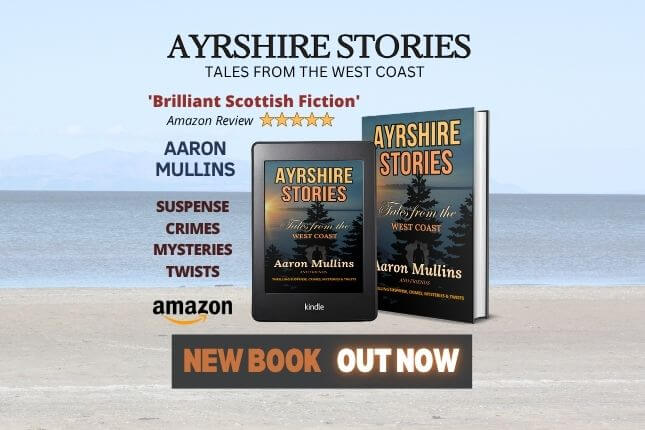
Ayrshire Stories: 18 Ghost, Crime & Mystery Tales of Ayrshire
Ayrshire Stories: Tales from the West Coast — Crime, Mystery and Ghost Stories Set in Real Ayrshire Places
Eight university students travelled from Strasbourg to Ayrshire with the same book in their bags. They’d spent a year reading about Monkton Woods, Ayr Harbour and Maidens Beach, and now they wanted to stand in them. I met them (and their Professor) to sign their copies, and I still can’t quite believe a book about my corner of Scotland brought them here.
Ayrshire Stories: Tales from the West Coast is a 2024 anthology of crime, mystery, suspense, ghost stories and speculative fiction by writers from across Ayrshire, Scotland. Every story is set in a real Ayrshire place, from Monkton Woods and Prestwick Main Street to Muirkirk, Stevenston and Culzean Castle. It reached number one in the Amazon charts in 13 countries.
If you love Scottish crime fiction, short stories you can finish in one sitting, or seeing your own streets turned sinister, this guide tells you what’s inside, who wrote it, and where to find it.
(more…) -

List of Scottish Mythical Creatures: 55 Legendary Folklore Monsters
55 Scottish Mythical Creatures
The selkie’s grave at St Trothan’s in Castletown has a hollow at its base that never dries out. Local children believed that if you put your foot in the water and whispered a wish, it would come true. I never did it. I was too feart of what might answer.
Scottish mythical creatures were never far away in a Caithness childhood. Scotland’s folklore is crowded with water horses, seal people, giants, fairies and loch monsters, and the most famous Scottish monster of all is the Loch Ness Monster, followed by the kelpie, the selkie and the unicorn, Scotland’s national animal. Below are the 55 Scottish folklore creatures from my book Scottish Legends: 55 Mythical Monsters, sorted by where you’d meet them, with a table that tells you where in Scotland each one lives.
What are Scottish mythical creatures?
Scottish mythical creatures are the monsters, spirits and shapeshifters of Scotland’s Gaelic, Scots and Norse folklore. The biggest group lives in water: 23 of the 55 below haunt lochs, rivers or the seas around Orkney and Shetland. The best known are the Loch Ness Monster, the kelpie, the selkie and the unicorn, Scotland’s national animal.
Most of them began as explanations. A storm that sank a boat in the Minch needed a cause, so the cause had blue skin and a taste for rhyme. A child who stopped walking needed a reason, so the fairies had swapped him.
I studied this for a living. My PhD looked at how perception shapes what we feel and do next, and folklore is that idea at full volume. Two people can stand on the shore of Loch Ness, watch the same wake roll in, and walk away with different stories. One saw a boat. The other saw Nessie, and told everyone in the pub.
The Vikings left their stories here along with their place names (Wick comes from the Norse ‘vik’, a bay). That’s why Orkney and Shetland have trows that look a lot like trolls, and why the Stoor Worm reads like a cousin of the Norse world serpent.

Contents
Quick reference: where each Scottish folklore creature and mythical monster lives
# Creature Type Where in Scotland Helpful or harmful Unicorn National animal Royal arms and mercat crosses nationwide Helpful 1 Bauchan Hobgoblin Highlands Both 2 Bodach Hobgoblin Highlands Harmful 3 Brownie Household spirit Farms and houses nationwide Helpful 4 Dunnie Brownie-like trickster Anglo-Scottish border, the Cheviots Prankster 5 Maggy Moulach Brownie Tullochgorm, Strathspey Helpful, until crossed 6 Redcap Goblin Border castles Harmful 7 Wirry-cow Bugbear, omen Lowland Scotland Harmful 8 Am Fear Liath Mòr Mountain presence Ben Macdui, Cairngorms Harmful 9 Bertram de Shotts Giant Shotts, on the Edinburgh to Glasgow road Harmful 10 Biasd Bheulach Shapeshifter Odal Pass, Isle of Skye Harmful 11 Fachan One-eyed giant Highlands Harmful 12 Baobhan sìth Vampire Highlands Harmful 13 Caoineag Banshee Highland clan lands Omen 14 Bogle Trickster ghost Lowlands and the Borders Prankster 15 Glaistig Goat-legged ghost Highlands, near water Both 16 Silkie Silk-gowned ghost Anglo-Scottish border Harmless 17 Ghillie Dhu Woodland fairy Gairloch, Wester Ross Helpful 18 Beast of Buchan Big cat Buchan, Aberdeenshire Harmful (to sheep) 19 Beithir Lightning serpent Highland corries Harmful 20 Black dog Spectral hound Nationwide Omen 21 Cat-sìth Fairy cat Highlands Harmful 22 Cù-sìth Fairy hound Highlands Omen 23 Galloway Puma Big cat Dumfries and Galloway Harmful (to sheep) 24 Pictish Beast Carved creature Pictish stones, north and east Unknown 25 Gigelorum Tiny beast Highlands Harmless 26 Wulver Wolf-man Shetland Helpful 27 Changeling Fairy substitute Nationwide (and Ireland) Harmful 28 Nicnevin Fairy queen Lowlands and the Borders Harmful 29 Pech Gnome-like race Lowlands Both 30 Seelie and Unseelie courts Fairy courts Nationwide Both 31 Sluagh Host of the dead Highlands and Hebrides Harmful 32 Trow Dark fairy Orkney and Shetland Harmful 33 Bean-nighe Washer at the ford Highland streams Omen 34 Blue Men of the Minch Storm spirits The Minch, by the Shiant Isles Harmful 35 Boobrie Shapeshifting bird West-coast lochs, Argyll Harmful 36 Ceasg Mermaid Highland seas and rivers Both 37 Cirein-cròin Sea serpent Highland seas Harmful 38 Each-uisge Water horse Highland lochs and sea lochs Deadly 39 Finfolk Sea sorcerers Orkney Harmful 40 Fuath Water spirit Highland rivers and lochs Harmful 41 Kelpie Water horse Rivers and lochs nationwide Deadly 42 Lavellan Poisonous water rodent Caithness and Sutherland Harmful 43 Loch Ness Monster Loch monster Loch Ness Unknown 44 Morag Loch monster Loch Morar, Lochaber Unknown 45 Muc-sheilch Loch monster Loch Maree, Wester Ross Unknown 46 Nuckelavee Sea demon Orkney Deadly 47 Nuggle Water horse Shetland Prankster 48 Oilliphéist Sea serpent Ireland (included for comparison) Harmful 49 Sea Mither Summer sea spirit Orkney Helpful 50 Selkie Seal person Orkney, Shetland and Caithness Both 51 Seonaidh Sea god Isle of Lewis Helpful, if paid 52 Shellycoat Water bogle Border rivers Prankster 53 Stoor Worm Sea serpent Orkney Deadly 54 Tangie Water horse Orkney and Shetland Harmful 55 Water bull Water spirit Highland moorland lochs Both The unicorn: Scotland’s national animal
The unicorn is Scotland’s national animal, and it’s been on the royal arms for centuries. Unicorns supported the Scottish royal shield from at least the 1500s, and tradition dates the link to William I in the 1100s. When James VI took the English throne in 1603, one unicorn gave way to the English lion, and the pair still face each other on the royal arms today.
The Scottish unicorn always wears a gold chain. You can see it on mercat crosses on Edinburgh’s Royal Mile and in Falcon Square, Inverness, and Scotland marks National Unicorn Day on 9 April. The unicorn isn’t one of the 55 in my book, which is why it sits here, above the count, with its chain on.
Scottish goblins and tricksters
Scottish goblins worked the farms and haunted the castles. Some played foul pranks on lazy servants. Others crept down chimneys at night to steal children.
If you try to meet one, make it the brownie. It’s the only creature in this section that does your washing up.
1. Bauchan
A bauchan is a Scottish hobgoblin that can’t make up its mind. At times it’s kind and helpful; at others it’s a rogue that does real harm, and the people who lived alongside one never knew which they’d get.
2. Bodach
A bodach takes its name from the Scottish Gaelic word for ‘old man’. In Highland tales it’s a hobgoblin tied to bad luck, and the nastier stories have it slipping down chimneys after children.
3. Brownie
A brownie (broonie in Scots, brùnaidh in Gaelic) is a small, shaggy household spirit that does the chores at night while the family sleeps. In return, you leave a bowl of milk or cream by the fire. A brownie that’s insulted or taken for granted can turn into something much worse, which is a fair warning for anyone with a flatmate.
4. Dunnie
A dunnie is a small brownie-like trickster from the Anglo-Scottish border, best known as the Hazlerigg Dunnie of Northumberland. It liked to turn itself into a horse, let a rider climb on, then vanish and leave them in the muddiest part of the road. On dark nights it wandered the Cheviots singing about the treasure it had lost.
5. Maggy Moulach
Maggy Moulach, or Hairy Meg, is the most famous brownie in the Highlands. She stood about two feet tall, with a great head of hair (or, in other tellings, hairy hands), and served the Grants of Tullochgorm in Strathspey. Her son, Brownie-Clod, was a dobie: a well-meaning brownie with very little in the way of brains.
6. Redcap
A redcap is an evil goblin that makes its home in the ruined castles along the border between Scotland and England. Of all the Border spirits, it’s the one you least want to find already living in your ruin.
7. Wirry-cow
A wirry-cow is less a creature than a fright. It’s an old Scots word for a bugbear, a goblin or an omen of evil: the thing you worried about in the dark, whatever shape it took.

Scottish giants and mountain monsters
Scotland’s giants mostly worked the roads. Some wanted gold or revenge. One just wanted to follow you down a mountain in the mist.
If you read about one, make it Am Fear Liath Mòr. It’s the only monster here reported by a professor of chemistry.
8. Am Fear Liath Mòr (the Big Grey Man of Ben Macdui)
Am Fear Liath Mòr is the Gaelic name for the Big Grey Man, a presence said to stalk Ben Macdui, the highest mountain in the Cairngorms and the second highest in Britain. In 1891, the mountaineer and chemist Professor Norman Collie was coming down from the summit cairn in mist when he heard footsteps behind his own, taking longer strides. He kept it to himself for 34 years, then told the Cairngorm Club in Aberdeen in 1925, and other climbers started admitting they’d heard them too.
One explanation is the Brocken spectre, where a walker’s own shadow is thrown huge onto mist. I’d add that a lone walker in fog, high up and tired, has a brain that fills the silence with whatever it fears most. Collie said he wouldn’t go back up there alone, and I don’t blame him.
9. Bertram de Shotts
Bertram de Shotts (sometimes Bartram) is a giant who attacked and robbed travellers on the road between Edinburgh and Glasgow, near Shotts in Lanarkshire. Every motorist on the M8 has met his descendants.
10. Biasd Bheulach
The Biasd Bheulach was a shapeshifter that haunted the Odal Pass on the Isle of Skye, near Kylerhea. It’s one of the few Scottish monsters with a single, named stretch of road to itself.
11. Fachan
The fachan is a Highland giant with one eye in the middle of its face, one leg, and one hand growing out of the centre of its chest. If the Cyclops had been drawn by a committee, this is what you’d get.
Scottish ghosts and ghouls
Scottish ghosts announce a death more often than they cause one. Banshees cry at waterfalls and bogles play tricks on the road. Up in the hills, a vampire in a green dress is waiting for a dance partner. (If Are You Afraid of the Dark? ever made a Highland episode, it would start here.) For the haunted castles and closes, see my 50 Scottish urban legends and ghost stories.
If you make friends with one, make it the baobhan sìth. It’s the one that turns up at a party.
12. Baobhan sìth
The baobhan sìth is a Highland vampire who appears as a beautiful woman, often to men out hunting, and dances with them before she turns and feeds. She’s the best argument in Scottish folklore for going home early.
13. Caoineag
The caoineag, the ‘wailing woman’, is a Highland banshee who foretells the death of a clan’s members by crying at night, usually beside a loch or a waterfall. Nobody ever sees her, which is worse.
14. Bogle
A bogle is a Scots and Border word for a ghost or goblin that would rather confuse and frighten you than serve you or kill you. The shellycoat (number 52) is a bogle, and a ‘tattie bogle’ is still a Scots word for a scarecrow.
15. Glaistig
The glaistig is a Scottish ghost who, like the baobhan sìth, appears as a beautiful woman in a green dress, with a grey face and long yellow hair. The dress hides her lower half, which is a goat’s.
16. Silkie
A silkie (no relation to the seal-folk selkie) is a female ghost of the Anglo-Scottish border who wore a rustling silk gown. She was quiet and solitary, and the only sound she made was the swish of silk as she worked.
17. Ghillie Dhu
The Ghillie Dhu is a shy, dark-haired male fairy who lives alone in the birch woods of Gairloch in Wester Ross. He’s one of the few creatures here with a reputation for kindness, especially to lost children.
Beasts, hounds and big cats
Scotland’s beasts include a wolf-man who leaves fish for the poor and a big cat that an MP took to the House of Commons. Their howls kept farmhouses awake, and the sheep they killed were found at first light.
If you go hunting for one, make it the Beast of Buchan. It’s often in the newspapers, so could make you famous.
18. Beast of Buchan
The Beast of Buchan is a big black cat reported in the Buchan area of Aberdeenshire since the 1930s. It became famous when the local MP, Alex Salmond, blamed it for attacks on livestock in his constituency and raised it in the House of Commons. A cat seen for ninety years can’t be one cat, which is why it gets called a phantom.
Big cats in the Highlands aren’t pure invention. In 1980 a real puma, later named Felicity, was caught near Inverness after locals reported a big cat in the hills. And the Kellas cat, a wildcat and domestic cat hybrid first found at Kellas in Moray, may explain some of the black-cat sightings in the north-east.
19. Beithir
The beithir is a huge serpent that appears at night when lightning strikes. Its Scottish Gaelic name is given different meanings by different sources, including serpent, lightning and thunderbolt, and one is said to live in Loch a’ Mhuillidh.
20. Black dog
The black dog turns up in folklore all over Britain. In Scotland it’s usually a demon, ghost or shapeshifter that comes out at night, and it may be the Devil himself, or one of his staff.
21. Cat-sìth
The cat-sìth is a large, spectral black cat with a white spot on its chest that haunts the Scottish Highlands. Some tales make it a fairy; others say it’s a witch who can turn into a cat nine times, and not one more.
22. Cù-sìth
The cù-sìth (the ‘fairy dog’) is a spectral hound that roams the Highland hills. It’s the size of a small cow, with a shaggy coat that’s dark green, which makes it the only dog in Scotland you’d spot more easily in the snow than on a hillside.
23. Galloway Puma
The Galloway Puma is a phantom big cat said to stalk the forests of Dumfries and Galloway. It’s the south-west’s answer to the Beast of Buchan, and just as camera-shy.
24. Pictish Beast
The Pictish Beast is a carved animal that appears again and again on Pictish symbol stones, and nobody can say what it is. It has a long snout, a curling crest and scrolled feet, and it’s been staring out of standing stones for over a thousand years without explaining itself.
25. Gigelorum
The gigelorum is the smallest creature in Scottish folklore. It’s said to be so tiny that it makes its home in a mite’s ear.
26. Wulver
The wulver is a kind Shetland creature with a man’s body, short brown fur and the head of a wolf. It lived alone in a cave by the shore, fished from a rock known as the wulver’s stane, and left fresh fish on the windowsills of poor families. Of all the 55, it’s the one I’d most like as a neighbour.

Scottish fairies and the fairy courts
Scottish fairies are rarely the kind with wands. They steal children and fly with the restless dead. They also sort themselves into two courts, one that might help you and one that certainly won’t.
If you’re looking for evidence of one, make it the changeling. It’s the only entry in this list with a real court case behind it.
27. Changeling
A changeling is a fairy left in place of a human child that the fairies have stolen. Sometimes the fairies left one of their elderly so that humans would care for it in its old age. A changeling looks exactly like the child it replaced, but over time, the stories say, it gives itself away.
The belief had real victims, and the two best-recorded cases are Irish. In 1826, in County Kerry, four-year-old Michael Leahy could neither stand, walk nor speak, and he was thought to be fairy-struck. An old woman, Anne Roche, had him bathed in the River Flesk three mornings running, and on the third he drowned. She said she was putting the fairy out of him, and at her trial in Tralee she was found not guilty of murder. In 1895, at Ballyvadlea in County Tipperary, Michael Cleary burned his wife Bridget to death, insisting she was a changeling and that he’d get his real wife back from the fairies.
I read both cases the same way. The changeling story gave frightened people a reason for an illness, or a change in someone they loved, that nobody could explain or treat. For Michael Leahy and Bridget Cleary, that story was fatal.
28. Nicnevin
Nicnevin is a Queen of the Fairies in Scottish folklore. Her name may come from Gaelic forms meaning ‘daughter of the divine’ or ‘daughter of the little saint’.
29. Pech
The Pechs were a short, strong, gnome-like race who, according to Scottish rhymes, brewed heather ale and fought the Scots. The name is the Lowland Scots word for the Picts.
30. The Seelie and Unseelie courts
Scottish folklore gave us the best-known way of sorting fairies: the Seelie Court and the Unseelie Court. The names come from the Scots word ‘seely’, meaning happy, lucky or blessed, and its opposite, ‘unseely’. Old Scots words make good monster names, as I found out the hard way when I tried writing Scots words for my own characters.
31. Sluagh
The sluagh, or sluagh na marbh (‘host of the dead’), is the flying host of the unforgiven dead in Scottish Gaelic folklore. It travels as a flying crowd, looking for souls to carry off.
32. Trow
A trow is a dark fairy of Orkney and Shetland: short, ugly and shy, but dangerous and full of mischief. Trows love music, and some Shetland fiddle tunes, the ‘trowie tunes’, are said to have been learned from them.

Scottish water monsters
Water monsters make up 23 of the 55. Some taught children to keep away from deep pools, and some warned young women about handsome strangers who smelled faintly of pondweed. The worst of them, the nuckelavee, has one weakness: it can’t cross fresh running water.
I bet of all the Scottish mythical creatures, you’ve heard of the Loch Ness Monster. It’s my favourite, and I’ve been looking for it on and off for most of my life.
33. Bean-nighe
The bean-nighe, the washerwoman, is a Highland banshee seen by lonely streams and pools, washing blood from the clothes of those about to die. In some tellings she’s the spirit of a woman who died in childbirth. If you see her at the ford, the shirt she’s scrubbing may be yours.
34. Blue Men of the Minch
The Blue Men of the Minch, also called storm kelpies, are blue-skinned sea spirits who live around the Shiant Isles, in the strait between Lewis and mainland Scotland. When a ship passed, their chief rose out of the waves and called out two lines of verse. If the captain answered in rhyme, the ship went through. If he couldn’t, the Blue Men raised a storm and sank it.
The folklorist Donald A. Mackenzie wrote the legend up in 1917 and wondered whether it began with North African captives held by Norse raiders in the Minch. Either way, it’s the only monster in Scotland you can beat with a good couplet, and I’d fancy my chances in Caithness Scots.
35. Boobrie
The boobrie is a shapeshifter that lives in the lochs of Scotland’s west coast, Argyll above all. It usually takes the form of a huge water bird, but it can turn into other monsters when a bird won’t do.
36. Ceasg
The ceasg is a Scottish mermaid with the upper body of a beautiful woman and the lower body of a grilse, a young salmon.
37. Cirein-cròin
The cirein-cròin is a sea serpent big enough to eat seven whales at a sitting, which is a lot to hide behind its party trick: disguising itself as a small silver fish.
38. Each-uisge
The each-uisge, the ‘water horse’, looks like a kelpie but is far more dangerous. It haunts sea lochs and lochs, appears as a fine horse or a handsome man, and drags anyone who mounts it into deep water. The folklorist Katharine Briggs counted it among the most dangerous water horses of all.
39. Finfolk
The Finfolk are a race of shapeshifting sorcerers who terrorise the shores of Orkney. They swim from their undersea home, Finfolkaheem, to hunt for human husbands and wives to carry off.
40. Fuath
A fuath (plural fuathan) is one of a family of malevolent Highland water spirits. The folklorist Donald A. Mackenzie placed them in Scotland’s seas, rivers and lochs.
41. Kelpie
The kelpie is a shapeshifting water horse that seems to live in every river and loch in Scotland. It appears as a horse by the water’s edge, and anyone who climbs on is carried under. Robert Burns named water-kelpies haunting the ford in his 1785 poem ‘Address to the Deil’, written here in Ayrshire, where I live now.
The kelpie is the second most famous Scottish monster after Nessie, and it has the biggest statues. Andy Scott’s two steel horse heads, The Kelpies, stand 30 metres (98 ft) high between Falkirk and Grangemouth, beside the Forth and Clyde Canal. They were completed in 2013, opened in April 2014, and modelled on two Clydesdales, Baron and Duke, as a tribute to the working horses of Scotland’s farms, canals and industry.
42. Lavellan
The lavellan is Caithness’s own monster: a water creature bigger than a rat, living in deep pools, with breath poisonous enough to sicken cattle at a distance. The 17th-century geographer Robert Sibbald called it common in Caithness, with a head like a weasel’s. When the naturalist Thomas Pennant toured the county in 1769, locals told him they kept the creature’s skin and cured sick cattle with water it had been dipped in.
Pennant thought the lavellan was a water shrew, which, as it happens, is one of the few venomous mammals in the world. Nobody in Wick ever warned me about it, which feels like an oversight.
43. The Loch Ness Monster
The Loch Ness Monster, Nessie (Niseag in Gaelic), is said to live in Loch Ness, which runs for about 23 miles (37 km) down the Great Glen, starting about 6 miles south-west of Inverness. The oldest story comes from Adomnán’s 7th-century Life of St Columba, in which Columba drives off a water beast in the River Ness, below the loch. The modern legend began with a wave of sightings in 1933, and the most famous photograph, the ‘surgeon’s photograph’ of 1934, is now known to be a hoax.
I’ve taken a cruise down the loch and paddled at the water’s edge a few times, which is either brave or daft depending on what you believe. Most of my visits came on the drive north, calling in on family in Inverness before the long road home to Wick. I’ve never seen her. I’ve never stopped looking either.
44. Morag
Morag is the monster of Loch Morar in Lochaber, the only loch in Scotland deeper than Loch Ness. In Alien Animals, Janet and Colin Bord collect accounts that make her sound a lot like Nessie’s cousin.
45. Muc-sheilch
The muc-sheilch is the monster of Loch Maree in Wester Ross, with a look all its own, and it was said to travel to other lochs nearby.
46. Nuckelavee
The nuckelavee is a horse-like sea demon from Orkney, and Katharine Briggs called it ‘the nastiest’ of all the demons of Scotland’s Northern Isles. Its name comes from the Orcadian knoggelvi, which the Orkney folklorist Walter Traill Dennison translated as ‘Devil of the Sea’. On land it appears as a skinless horse with a man’s body growing from its back, and its breath was blamed for blighted crops and sick livestock.
In 1891 Dennison recorded the account of an islander called Tammas, who met the nuckelavee and escaped by crossing a stream running from a loch, because the demon can’t cross fresh running water. Only one spirit can control it: the Sea Mither (number 49), who keeps it locked away through the summer.
I wrote a nuckelavee into Call of the Nuckelavee, one of the stories in Mysteries and Misadventures: Tales from the Highlands. A woman walks the dunes of an Orkney beach, following the voice of her drowned father, until a dog she recognises beckons her into the sea. Some of the fear in it came from a cave outside Budapest: lights off, total silence, and the ringing in my ears.
47. Nuggle
The nuggle (also noggle or shoopiltee) is a Shetland water horse that haunts the lochs, streams and shores of the islands. Nuggles are always male, come out only at night, and play pranks on islanders and travellers.
48. Oilliphéist
The oilliphéist is an Irish sea serpent, included here because it’s so often compared to Nessie. Its name comes from the Irish oll (‘great’) and péist (‘worm, monster’). In one tale it carved out the River Shannon as it fled to the sea. In another it swallowed a drunken piper called O’Rourke, who kept playing in its stomach until it spat him out.
49. Sea Mither
The Sea Mither, or Mither o’ the Sea, is a powerful Orcadian summer spirit who fights an endless battle for the seas with her enemy Teran, the spirit of winter. She’s also the only one who can keep the nuckelavee locked up, which makes her the most useful creature in Orkney.
50. Selkie
A selkie is a seal that can shed its skin and walk ashore as a human. The best-known tale has a man steal a selkie woman’s skin so she has to marry him. She gives him children, but the day she finds the skin, she’s back in the sea.
The selkie I grew up with is buried at St Trothan’s, Castletown. A fisherman found a baby girl wrapped in sealskin and raised her. She grew up seeing the devil in the church rafters, was banned from the church, and died in childbirth. The hollow at the base of her grave never dries out. It’s the only grave I know with its own water supply, and the only wish I never made.
51. Seonaidh
Seonaidh, or Shony, was a sea god of the Isle of Lewis. The writer Martin Martin recorded in 1703 that at Hallowtide (Halloween), each family gave malt for ale, and one man waded into the sea up to his waist with a cup of it. He asked Shony for plenty of seaweed to feed the fields, threw the ale into the waves, and the whole parish spent the rest of the night drinking and dancing in the fields. It’s the only Halloween tradition in this list that ends in a ceilidh.
52. Shellycoat
The shellycoat is a water bogle of Scotland’s Border rivers, named for its coat of shells, which rattles when it moves. In one tale, two men by the Ettrick heard a voice crying ‘Lost! Lost!’ from the water and followed it upstream all night, all the way to the river’s source. Then they heard the shellycoat laughing at them.
53. Stoor Worm
The Stoor Worm, or Mester Stoor Worm, is a gigantic sea serpent from Orkney whose breath poisoned crops, animals and people. It looks like a cousin of Jörmungandr, the Midgard Serpent of Norse mythology.
54. Tangie
A tangie is a shapeshifting water spirit of Orkney and Shetland that takes the form of a horse or a man, usually draped in seaweed.
55. Water bull
The water bull (tarbh-uisge in Gaelic) is a shapeshifter like the water horses, but it prefers the shape of a bull. It haunts moorland lochs and now and then takes human form.

Scottish cryptids: the folklore creatures people still report
Scottish cryptids are folklore creatures with modern sightings behind them: animals people still claim to see on Scotland’s lochs and hills. The best known are the Loch Ness Monster, Morag of Loch Morar, the Big Grey Man of Ben Macdui and the Beast of Buchan. One big cat really was caught.
Cryptid Where Best-known evidence Loch Ness Monster Loch Ness, Highlands A wave of sightings in 1933, and the 1934 ‘surgeon’s photograph’, later shown to be a hoax Big Grey Man (Am Fear Liath Mòr) Ben Macdui, Cairngorms Professor Norman Collie’s account of footsteps in the mist, told to the Cairngorm Club in 1925 Beast of Buchan Buchan, Aberdeenshire 22 sightings recorded between May 2000 and January 2002, and the local MP, Alex Salmond, raising it in the House of Commons Felicity the puma Near Inverness A real puma, caught in 1980 after locals reported a big cat in the hills Morag Loch Morar, Lochaber Accounts collected by Janet and Colin Bord in Alien Animals Scottish folklore legends: beyond the monsters
Scottish legends include heroes and hauntings as well as mythical monsters. Robert the Bruce took heart from a spider that kept trying to climb its thread, Glamis Castle is famous for its ghosts, and Edinburgh’s Mary King’s Close has a claim to be the most haunted street in the capital. I’ve gathered those stories in 50 Scottish urban legends, myths and folklore tales. The human monsters, the ones who really existed, are in my Scottish true crime stories.
“This is the fourth book I have read from the same author. Again another interesting read. I always enjoy reading short stories, tales, legends about Scotland.”
Amazon Review ★★★★★Scottish Mythical Creatures FAQ
What mythical creature is associated with Scotland?
The unicorn is the mythical creature most associated with Scotland, because it’s the national animal and has supported the Scottish royal arms since at least the 1500s. The most famous Scottish monster, though, is the Loch Ness Monster, followed by the kelpie, honoured by Andy Scott’s 30-metre Kelpies sculptures near Falkirk.
What are fairies called in Scotland?
Scottish Gaelic calls the fairies the daoine sìth, which means ‘people of the fairy mound’. In the north of Scotland, folklorist Walter Gregor recorded them being called ‘the Fair Folk’ or ‘the Good Neighbours’, and Scots also spoke of ‘seely wights’. Polite names like these may have been a way of keeping the fairies from taking offence.
What’s the difference between a kelpie and an each-uisge?
A kelpie and an each-uisge are both Scottish water horses that drown anyone who rides them. The kelpie is the more widespread, haunting rivers and lochs across Scotland. The each-uisge lives in Highland lochs and sea lochs, and folklorist Katharine Briggs counted it among the most dangerous water horses of all.
What is the most evil Scottish mythical creature?
The nuckelavee of Orkney has the strongest claim to be the most evil Scottish mythical creature. Folklorist Katharine Briggs called it ‘the nastiest’ of all the demons of Scotland’s Northern Isles. On land it appears as a skinless horse with a man’s body growing from its back, and its breath was blamed for blighted crops.
Are there really big cats in Scotland?
Scotland has one native wild cat, the Scottish wildcat, but big-cat sightings in Buchan go back to the 1930s. In 1980 a real puma, later named Felicity, was caught near Inverness. Some black-cat sightings in the north-east may be Kellas cats, wildcat and domestic hybrids first found in Moray.
Scottish mythical creatures in my life
I first heard Tam o’ Shanter at a primary school Burns Night in Wick. What stayed with me was the chase: Nannie the witch reaching for Tam’s grey mare, Maggie, and Tam galloping for the bridge over the Doon, because no witch can follow you across running water. Maggie made it, minus her tail.
Plenty of the Scottish mythical monsters in this list can be beaten with a trick that simple. Get to the stream before the nuckelavee does. Answer the Blue Men in rhyme. Leave the brownie its cream. And never climb on a horse you find standing by a loch.
And if you’re ever in Castletown, leave the selkie’s hollow alone. It never dries, and it doesn’t need your foot in it.
‘Mind an’ keep til eh runnin’ watter.’
Which Scottish mythical creatures did your granny use to keep you away from the water? Tell me in the comments, and if I’ve missed a monster from your corner of Scotland, give me its name and its story.

The full tales of all 55, and the people who swear they met these creatures and lived to tell the tale, are in my book Scottish Legends: 55 Mythical Monsters. It reached Amazon’s top 100 on the day it came out. Read Scottish Legends on Amazon.
Happy reading,
Aaron Mullins
Subscribe to get free stories
Pop in your email to join over 2,000+ readers and writers who receive free stories, tips, and advice:
-

50 Scottish Urban Legends: Creepy Myths, Folklore Tales and the Truth Behind Them
These 50 Scottish urban legends are the ones I’d tell you on a dark night, and after each one you’ll get the true story behind it. There are Scottish ghost stories from haunted castles, Edinburgh urban legends from under the Royal Mile and Glasgow urban legends that made the newspapers. The rest is creepy Scottish folklore, the Scottish myths and folklore tales that still give names to our caves and lochs.
In Wick, the axeman lived two streets over from my house. Kick his lamppost until its light went out and he’d come for you. So, naturally, we took turns. He never came for me. The nearest we got to danger was the night we picked a lamppost outside the police houses, which ended in a hasty jog up the riverside.
That’s the general pattern behind most the Scottish urban legends on this list. Take a real place and an ancient rule, then see what happens when you test it.
Most lists of Scottish ghost stories give you the spooky half and stop before you find out what happened. Here, every legend ends with the truth as far as the records go, and where you can see the evidence.
I’ve grouped the 50 into haunted houses first, then Edinburgh and Glasgow, then the roads, the crimes, the monsters and my own Wick ghost story. Midnight Society rules apply.

Creepy Myths and Folklore Tales
- The most famous Scottish urban legends are Sawney Bean, the Gorbals Vampire, the Mackenzie Poltergeist and the Flannan Isles Lighthouse.
- Several have hard evidence behind them. You can still see the Arthur’s Seat coffins, the Devil’s card table and a horn cut from a woman’s head in 1671.
- Others fall apart on inspection. Sawney Bean first appears in an 18th-century London crime catalogue, and historians have found no record of him from his own time.
- For one legend you can see with your own eyes, start with the Arthur’s Seat coffins in the National Museum of Scotland.
Contents
What are the most famous Scottish urban legends?
The most famous Scottish urban legends are Sawney Bean, the Ayrshire cave cannibal, the Gorbals Vampire hunted by Glasgow children in 1954, the Mackenzie Poltergeist of Greyfriars Kirkyard and the Flannan Isles keepers who vanished in 1900. Each grew from a real place, and three of the four have records you can still check.
If you only read one, make it the Flannan Isles at number 50. It’s the one I chose to tell on camera, and it’s the best example on this list of a true event that rumour has dressed up as a Scottish urban legend.
Creepy Scottish folklore in haunted castles and houses
Scottish ghost stories cluster around big houses, because big houses kept records, and records give a legend something to cling on to.

1. The House of the Binns and the Devil’s card table
General Tam Dalyell, known as ‘Bluidy Tam’, was said to play cards with the Devil at the House of the Binns in West Lothian. The Devil always won, until Tam propped a mirror behind the table and read his hand. Auld Nick spotted the cheat and threw the heavy marble table at him. It missed, flew outside and sank in the Sergeant’s Pond. Nobody believed a word of it. Then, in the drought of 1878, the pond dried up and there was the table. It’s back in the entrance hall now, with a dark mark on one corner that visitors call the Devil’s hoof print (National Trust for Scotland).
2. The Green Lady of Crathes Castle
Crathes Castle, a 16th-century tower house near Banchory in Aberdeenshire, has a room named after its ghost. The Green Lady crosses the Green Lady’s Room, stops by the fireplace and lifts a baby out of thin air, and Queen Victoria is said to be one of the people who saw her. The detail that keeps this story going came in the 1800s. Workmen lifting the hearthstone found the bones of a child underneath, and some accounts add a woman.
3. The footsteps of Skaill House
Skaill House, on Orkney’s west coast near Skara Brae, was built around 1620 for Bishop George Graham, and part of it stands on an old burial ground. Visitors report footsteps in empty rooms and dogs barking at nothing. One ghost has been there long enough to earn a name, Ubby. The bones are real. Drainage works at the house uncovered a medieval cemetery, and archaeologists dated the burials to between the 11th and 14th centuries.
4. The haunted room at Castle Stuart
Castle Stuart, near Inverness, was finished around 1625 for the third Earl of Moray, and one turret room had such a reputation that nobody would stay in it. The story goes that four local men agreed to sit a night each for a £20 reward. The minister dreamt of a giant covered in blood. The church elder was found fainted on the floor. The shoemaker saw a dark shape with cloven hooves. Last came Rob Angus, a poacher the size of a door who was scared of nothing. ‘You will find me as I am, or dead,’ he told the servant. In the morning they found him dead beneath the broken window.
5. The Green Lady of Ackergill Tower
Ackergill Tower stands on Sinclair’s Bay, a short drive north of Wick, so this one belongs to my home town. In the 1400s Dugald Keith carried off Helen Gunn, the ‘Beauty of Braemore’, on the eve of her wedding to another man and locked her in the tower. She fell, or jumped, from the top while trying to escape, and the feud between the Keiths and the Gunns grew bloodier from there. She’s still seen as a Green Lady on the battlements. The tower ran as a hotel for years, closed around 2019 and is now a private home, so admire it from the coast. Keep the Keith name in mind. It turns up again at number 29.
6. The Monster of Glamis
Glamis Castle in Angus picked up its monster from Victorian gossip. The story said a secret chamber held a deformed child of the family, an heir the world had been told was dead. Nobody has ever produced the room. Of all 50, this is the one I trust least, because a legend about a hidden room can never be disproved, only repeated.
Edinburgh urban legends
Edinburgh urban legends lean on the old town’s habit of building on top of itself, so a good half of them happen underground or behind locked gates.

7. Annie’s room in Mary King’s Close
The Real Mary King’s Close is a set of 17th-century streets and houses buried under the Royal Mile. In 1992 the Japanese psychic Aiko Gibo, filming a documentary, said a little girl called Annie clutched at her in one room. Annie had been left behind during the plague, Gibo said, and had lost her favourite doll. Gibo bought a doll on the Royal Mile and left it for her, and visitors have been leaving toys in the room ever since. On 17 April 2019 a guide radioed in to say the original doll was gone. The attraction later found it was a tartan-clad Daisy doll designed by Mary Quant.
8. The Mackenzie Poltergeist
Sir George Mackenzie was Lord Advocate when about 1,200 Covenanter prisoners were held in a corner of Greyfriars Kirkyard after the Battle of Bothwell Bridge in 1679, and his prosecutions earned him the name ‘Bluidy Mackenzie’. He was later buried a few yards away, in the Black Mausoleum. Generations of Edinburgh children dared each other to shout through the keyhole, ‘Bluidy Mackenzie, come oot if ye daur, lift the sneck and draw the bar!’ In the late 1990s a homeless man broke into the tomb looking for shelter. Since then, people on ghost tours have reported bruises and scratches, and a few have fainted near the mausoleum.
9. The Headless Drummer of Edinburgh Castle
Edinburgh Castle’s drummer is heard more often than he’s seen, a lonely beat on the ramparts when the castle is quiet. When people do see him, he has no head. The usual telling says his drumming warns that the castle is about to be attacked, which makes him one of the few ghosts on this list who’s on your side.
10. Albert of the Edinburgh Playhouse
The Edinburgh Playhouse on Greenside Place opened as a cinema and is now one of the biggest theatres in the UK. Staff talk about Albert, a man in a grey coat who appears on level six with a sudden drop in temperature. He’s said to have been a stagehand killed in an accident or a night watchman who died in the building. In one version, police called to a break-in in the 1950s spoke to an older man called Albert on level six, then learned the next day that Albert had died some time before. The theatre named Albert’s Bar after him.
11. The Arthur’s Seat coffins
In late June 1836, boys hunting rabbits on the north-east slopes of Arthur’s Seat pulled back some slates and found 17 miniature coffins, stacked in two tiers of eight with one more on top. Each held a carved wooden figure. Several were destroyed when the boys threw them at each other, and eight survive in the National Museum of Scotland. Nobody knows who made them or why. The favourite theory ties them to the 17 victims of Burke and Hare, though the surviving figures are all dressed as men and most of the victims were women.
12. The Unicorn Woman’s horn
On 14 May 1671 a surgeon called Arthur Temple cut a horn from the head of a woman named Elizabeth Love, about three inches above her ear. It had been growing for seven years. The horn is in the University of Edinburgh’s Anatomical Museum, with a small engraved medallion naming the witnesses to the operation. Doctors call it a cutaneous horn, a hard growth of keratin, the same material as your fingernails.
Glasgow urban legends
Glasgow urban legends are younger than most, and the best of them reached the national newspapers within living memory.
13. The Gorbals Vampire
On the evening of 23 September 1954, police were called to the Southern Necropolis in the Gorbals and found hundreds of children, some as young as four, armed with stakes and kitchen knives. They were hunting a seven-foot vampire with iron teeth that, according to the playground, had eaten two local boys. Nobody was missing. Newspapers blamed American horror comics, and the panic helped pass the Children and Young Persons (Harmful Publications) Act 1955, which is still law.
The iron teeth are the detail that interests me. They’re older than any comic. A beast with ‘great iron teeth’ appears in the Book of Daniel, and Glasgow schools taught a 19th-century poem about Jenny wi’ the Airn Teeth, a bogeywoman of Glasgow Green. It probably helped that the Dixon’s Blazes ironworks lit the graveyard red every night. A rumour spreads fastest when it borrows a fear people already carry.
14. Cathedral House Hotel
Cathedral House, on Cathedral Square opposite the Necropolis, opened in 1877 as a hostel for prisoners released from Duke Street Prison. Susan Newell was hanged at Duke Street in October 1923 for strangling a newspaper boy, and she remains the last woman executed in Scotland. Guests report an invisible presence brushing past them on the stairs, and children playing on the top floor when there are no children in the building. It’s a boutique hotel now, so you can test the stairs yourself.
15. The girl in the Arches
The space under Glasgow Central station lay derelict until 1990, when it held an exhibition for the city’s year as European City of Culture. Then it became The Arches, an arts venue and nightclub, until it closed in 2015. Staff told of a lost-looking girl in old-fashioned clothes in the lower corridors, so real that people offered to help her before she vanished. In 2009 the cast of an Alien Wars show reported that she screamed and fled whenever they came near. The arches host events again today as Platform.
16. Provan Hall
Provan Hall, in Easterhouse, is a 15th-century hunting lodge built for the bishops of Glasgow and one of the oldest houses in the city. Its darkest story is a soldier who came home after two years away, found his wife with a baby boy, and killed them both in the master bedroom. Mother and son are said to be seen upstairs. Reston Mather, the last private owner, died in the house in 1934 and is said to stand on the staircase. Provan Hall reopened in 2023 after restoration, and paranormal groups queued to get in.
17. Dalmarnock Bridge
Dalmarnock Bridge carries Dalmarnock Road across the Clyde, and there’s been a crossing here since a wooden bridge went up in 1821. The present iron bridge dates from 1889–91. The legend is a man at the rail, staring down into the water. People who stop to help say he leaps, then vanishes before he reaches the river. If that story sits close to home for you, Samaritans are free to call on 116 123, day or night (Samaritans Scotland).
18. The bird, the tree, the bell and the fish
Glasgow’s coat of arms packs four legends of St Mungo onto one shield, and many Glaswegians can still recite the rhyme. ‘Here is the bird that never flew, here is the tree that never grew, here is the bell that never rang, here is the fish that never swam.’ The bird was St Serf’s tame robin, killed by Mungo’s classmates and brought back to life by Mungo. The tree began as frozen hazel branches he set alight to restart a fire. The bell is said to have come from Rome. The fish was a salmon from the Clyde with a lost ring in its mouth, and it saved Queen Languoreth from execution.
19. Overtoun Bridge
Overtoun Bridge, finished in 1895 on the drive to Overtoun House near Dumbarton, has an ugly local nickname, the dog suicide bridge. Since the 1960s, around 50 dogs are reported to have died after leaping the parapet from the same spot, almost all of them long-nosed breeds. In 2010 the canine psychologist David Sands studied the bridge from a dog’s height. He concluded the likeliest lure was the scent of mink in the gorge below, with the drop invisible until it was too late. I walk my dog on the beach most days. Here, I’d keep the lead on.
Scary Scottish folklore on the roads, in the caves and up the mountains
Scary Scottish folklore loves a lonely road and a dark cave, and Scotland has plenty of both.
20. The A75 Kinmount Straight
The A75 Kinmount Straight, a four-mile stretch between Carrutherstown and Annan in Dumfries and Galloway, is called Scotland’s most haunted road. Its best-known night came in 1962, when brothers Derek and Norman Ferguson said a hen flew at their windscreen and vanished on impact. An old woman waving her arms followed it, then a screaming man and a parade of animals. Last, a furniture van came straight at them and disappeared. Later drivers report hitting a figure that runs into the road, then finding no body when they stop.
21. The Ghillie Dhu
The Ghillie Dhu is a shy, wild-haired fairy of the birch woods around Gairloch in Wester Ross, dressed in leaves and moss. He avoids adults but is kind to children. In the best-known story he found a lost girl in the woods and walked her safely home. His reward was a hunting party of five men sent to capture him. They never found him.
22. The Old Man of Storr
The Old Man of Storr is a pinnacle of rock on the Trotternish Ridge of Skye. Legend says a giant lived on the ridge, and when he was buried his thumb was left sticking out of the ground. Stand underneath it on a misty day and the idea gets much easier to believe.
23. MacKinnon’s Cave
MacKinnon’s Cave, under the Gribun cliffs on Mull, is one of the deepest sea caves in the Hebrides, and Dr Johnson and James Boswell measured it in 1773. Abbot MacKinnon is said to have hidden here in the 15th century. The darker story is a piper who walked in with his dog to outplay the fairies. Only the dog came back, terrified and hairless. You can reach the cave only around low tide, so check the tide tables before you set off.
24. Fingal’s Cave
Fingal’s Cave on Staffa is made of six-sided basalt columns, the same rock that forms the Giant’s Causeway in Northern Ireland. One legend names it after Fionn mac Cumhaill, the Irish giant also called Finn McCool. The other story is literary. In 1761 James Macpherson published Fingal, an epic he claimed to have translated from ancient Gaelic. When Sir Joseph Banks visited in 1772, at the height of the craze for Macpherson’s poems, the name stuck. Before that, the cave was known in Gaelic as An Uamh Bhinn, the melodious cave, for the way the sea echoes inside it.
25. The Corryvreckan whirlpool
The Gulf of Corryvreckan, between Jura and Scarba, has a whirlpool fierce enough to need two legends. In the first, the Cailleach Bheur, the hag goddess of winter, washes her great plaid in it, and when she lays it out white across the land, winter has arrived. In the second, a Norse prince called Breacan tried to win a princess by mooring his boat by the whirlpool for three days and nights. He brought ropes of wool, hemp and a maiden’s hair, trusting the hair to hold because its owner was pure. All of them snapped, Breacan drowned, and the maiden admitted she wasn’t as pure as she’d claimed.
26. Am Fear Liath Mòr, the Big Grey Man
Ben Macdui, at 1,309 metres the second-highest mountain in Britain, is home to Am Fear Liath Mòr, the Big Grey Man. In 1925 the mountaineer Professor Norman Collie told the Cairngorm Club that, alone near the summit in 1891, he’d heard crunching footsteps behind him, one for every few of his own, and fled down the mountain in terror. Walkers since describe a towering grey figure, or a sudden dread that tells them to leave.
27. The piper of Clanyard Bay
Clanyard Bay, on the Rhins of Galloway near Stranraer, has a twin of the MacKinnon’s Cave story. A piper went into the caves to find the fairies, playing so the people above could follow him. The music grew fainter until it stopped, and his dog ran out hairless. Locals say you can still hear pipes under the fields at night. The same tale turns up under Edinburgh Castle and in caves on Tiree, which tells you how well a good story travels.
28. Machrie Moor and the standing stones
The Calanais Standing Stones on the west coast of Lewis were raised in a rough cross shape about 5,000 years ago, and Orkney’s Ring of Brodgar is a near-perfect circle inside a Neolithic henge. My pick for a legend is Machrie Moor on Arran, where six stone circles stand on open moorland. One double ring is called Fingal’s Cauldron Seat, and the giant Fingal is said to have tied his dog Bran to a stone in the outer ring while he ate (Historic Environment Scotland). Arran is in North Ayrshire, so it’s the closest of the three to my own front door.
True crime behind Scottish urban legends
Some of the best Scottish horror stories started as crime reports, and this is where the psychologist in me does most of the work. For the cases that stayed in the courtroom, my guide to Scottish true crime stories goes further.
29. Three Bloody Strokes
In the legend of the Battle of Barry in Angus, in 1010, a warrior later claimed as the first of the Keiths chased the Danish leader Camus into the hills and killed him. King Malcolm II dipped three fingers in Camus’s blood and drew three red lines down the warrior’s shield. The Keith chiefs still carry those three stripes, and their motto, Veritas Vincit, means ‘truth conquers’. The awkward truth is that the battle may never have happened. An 1881 account suggested it was invented to explain old burials found at the site, and its main source, the chronicler Hector Boece, probably drew on local folklore.
30. Lady Finella the king killer
Kenneth II really was killed at Fettercairn in 995, and the Annals of Ulster say it was ‘by deceit’. Legend names the deceiver as Lady Finella, whose son the king had killed. She lured him to a house where a statue stood in the middle of the room, rigged to hidden crossbows. When the king touched it, the bolts fired from every side. Finella fled to the coast and, cornered by the king’s men, threw herself from the waterfall near St Cyrus still marked on maps as Den Finella.
31. The Burning Bishop of Caithness
This one is from my home county. Adam of Melrose, Bishop of Caithness, raised his butter tax from a span of butter for every 20 cows to one for every 10. The farmers complained to Earl Jon Haraldsson, who ruled Orkney under the King of Norway and Caithness under the King of Scots. Retellings give the earl the line ‘The devil take the bishop and his butter; you may roast him if you please!’ On 11 September 1222, a crowd gathered at the bishop’s house in Halkirk and shouted ‘Roast him alive!’ They dragged him into his kitchen and burned it down with him inside. King Alexander II came north to punish them, and he wasn’t gentle about it.
32. Sawney Bean
Sawney Bean is the goriest of all Scottish horror stories, and it’s set on my adopted coast. Legend puts him and his wife Agnes in a cave at Bennane Head, between Girvan and Ballantrae in South Ayrshire. Over 25 years they raised a clan of about 45 children and grandchildren, ambushed travellers on the coast road, and killed and ate more than 1,000 people. A search party sent by James VI found the cave, and the whole family was executed in Edinburgh. Historians have found no record of any of it from the time. The story first appears in the Newgate Calendar, an 18th-century crime catalogue published in London and known for its gore.
My guess is that a lonely road with real robberies needed a monster to explain the travellers who never arrived home. If you like your Ayrshire darker, here are the writers and books set in Ayrshire.
33. The ghosts of Culloden
On 16 April 1746, the Jacobite army of Charles Edward Stuart met the government army of the Duke of Cumberland on Culloden Moor near Inverness. Scots fought on both sides. The battle took less than an hour, and around 1,300 men died, about 1,250 of them Jacobites (National Trust for Scotland). Visitors to the moor report a tall Highlander in tartan who walks among the clan graves and whispers one word, ‘defeated’.
34. Isobel Gowdie, Queen of the Witches
In 1662, Isobel Gowdie, a farm labourer’s wife from Lochloy near Auldearn, gave four confessions to witchcraft over six weeks, and there’s no record that she was tortured. She described flying with her coven, meeting the Queen of the Fairies and turning into a hare with a charm that began ‘I shall go into a hare’. No record survives of her execution, or of anything after. People confess to impossible things for reasons that make sense to them, such as fear or the hope of mercy, and Isobel told her interrogators the most detailed story of any Scottish witch trial. Historians still argue over why.
35. The death of Netta Fornario
In November 1929, the body of Norah Emily Editha Fornario, known as Netta, was found on the island of Iona near Loch Staonaig, on a mound island legend linked to the fairies. She was naked apart from a black cloak and a blackened silver cross, and she lay on a large cross cut into the turf, with a knife nearby and her feet cut and scratched. She’d come to Iona from the London occult scene, a friend of the occultist Dion Fortune, and two days earlier had tried in a panic to leave the island. Her death certificate gives exposure. Fortune blamed a psychic attack.
Scottish monster myths
These Scottish folklore tales are the oldest on the list, the myths and legends of Scotland with teeth and claws. I’ve kept them short, because my list of Scottish mythical creatures gives each one a full entry.
36. The Blue Men of the Minch

The Blue Men of the Minch, also called Storm Kelpies, live in the strait between the Outer Hebrides and the mainland. They’re blue-skinned and swim just under the surface, waiting for ships to sink. In the version Donald Mackenzie collected in 1917, their chief challenges a ship’s captain in rhyme. A captain who can answer every line sails on. One who runs out of words loses his ship.
37. The zombie priest of Melrose
The chronicler William of Newburgh, writing in the 1190s, told of a priest at Melrose so fond of hunting with hounds that he was nicknamed the Hundeprest, the dog-priest. After his death in about 1196 he rose from his grave, tried to break into the abbey and visited the bedroom of his former mistress. Four monks kept watch at his grave. When three left to warm up, he rushed the last one, who struck him with an axe and drove him back underground. The next morning the monks dug up the body, still fresh and bleeding from the wound, and burned it to ashes.
38. The Nine Maidens and the Dundee dragon
A farmer at Pitempton, near Dundee, sent his eldest daughter to the well for water. When she didn’t come back he sent the next, then the next, until all nine were gone. He found them dead by the well with a great serpent coiled beside them. A young man called Martin, sweetheart of one of the daughters, chased it down while the crowd shouted ‘Strike, Martin!’, which folk etymology turned into the place name Strathmartine. A Pictish carved stone at Balluderon is still called Martin’s Stone, and a dragon statue stands on Dundee’s High Street.
39. The Stoor Worm
In Orkney the Stoor Worm, or Mester Stoorworm, was a sea serpent so vast that it woke on Saturday mornings and yawned nine times. A sorcerer told the king to feed it seven maidens every week, or give up his own daughter, Princess Gem-de-lovely. The king offered her hand, and Odin’s sword Sickersnapper, to anyone who could kill it. The winner was Assipattle, a farm boy who spent his days lying in the ashes. He sailed into the worm’s mouth and set fire to its liver with a burning peat. The dying worm’s teeth became Orkney, Shetland and the Faroes, and its body became Iceland.
40. The Loch Ness Monster
Nessie is my favourite, and I’ve stopped at Loch Ness more times than I can count, visiting family in Inverness or driving north to Wick. The first story comes from Adomnán’s Life of St Columba, which says that in 565 Columba drove a beast back into the River Ness. The modern monster arrived in 1933, when the Inverness Courier reported a couple’s sighting of a huge creature from the A82. The famous ‘Surgeon’s Photograph’ followed in 1934, and in 1994 Christian Spurling confessed it had been a toy submarine with a sculpted head. People still look. So do I.
41. The Boneless
Shetland’s Boneless, called the Frittening in older tellings, is barely a creature at all. People describe a pale mass with no shape, wet and foul-smelling, that comes in from the shore at night. It doesn’t hunt like a monster. It arrives before a disaster, which is worse.
Scottish folklore tales behind the national symbols
Scotland’s flag, flower and best-known saying all come with a battle story attached.
42. The Saltire
St Andrew is said to have been martyred at Patras in Greece around 60 AD on an X-shaped cross, because he refused to die on the same shape of cross as Christ. Scotland’s flag comes from a later legend. In 832, King Óengus II of the Picts, outnumbered by the Angles near what’s now Athelstaneford in East Lothian, prayed for victory and saw a white saltire of cloud against a blue sky. He won, and the white cross on blue became Scotland’s flag. The village has a Flag Heritage Centre in an old doocot beside the church.
43. The thistle at Largs
In the late summer of 1263 King Haakon IV of Norway brought a fleet to the Ayrshire coast. Legend says his men took their boots off to creep up on the sleeping Scots in the dark, and one of them stood on a thistle. His yell woke the camp, the Scots won the Battle of Largs, and the thistle became Scotland’s flower. The plant was most likely the spear thistle, a common native species, rather than the cotton thistle on most badges, which probably didn’t grow in medieval Scotland. Largs is a short way up the coast from me, and the thistles there still hurt.
44. Robert the Bruce and the spider
The story goes that Robert the Bruce, beaten and hiding in a cave, watched a spider fail again and again to fix its web, until it finally succeeded, and took it as a sign to fight on. Caves on Rathlin Island and at Kirkpatrick Fleming both claim him. The spider seems to have reached Bruce through Walter Scott’s Tales of a Grandfather in the late 1820s, and an earlier version was told about his ally James Douglas. The line ‘If at first you don’t succeed, try, try again’ is younger still. It comes from William Hickson’s The Singing Master, published in 1836.
45. The Templar knights at Bannockburn
Legend says Robert the Bruce won at Bannockburn in 1314 with help from a band of Knights Templar, who had fled France after their order was suppressed. In the story, a charge of mysterious riders breaks the English line at the decisive moment. The details change with every telling, and the earliest accounts of the battle don’t name them.
46. The Brahan Seer
Coinneach Odhar, the Brahan Seer, is Scotland’s Nostradamus, a labourer on the Seaforth estate near Dingwall who saw the future. He’s credited with foreseeing Culloden, and a day when Scotland would have its own parliament again. His last vision, the story goes, showed Lord Seaforth with another woman, and Lady Seaforth had him burned in a spiked tar barrel at Chanonry Point, where a memorial stone stands by the lighthouse. Records do show a Coinneach Odhar wanted as a ‘principal enchanter’ in 1577, a century before the legend’s date. He also warned that if the Eagle Stone in Strathpeffer fell three times, ships would sail to the village. It has fallen twice, and it’s now set in concrete.

Unexplained Scotland, including my own Wick ghost story
The last four are the Scottish ghost stories I’d tell first, two of them from Caithness.
47. Wick North Primary School
This one is mine. It was a warm evening and I was playing football on the ground in front of Wick North Primary, where you could see into every classroom window. Near home time I glanced up, and there was my old primary 5 teacher, or so I thought, looking down at us from one of the windows. She had long hair past her shoulders and a white dress, and she looked grey, which I put down to the setting sun on the glass. I waved. She didn’t wave back. She just kept staring. When a friend asked what I was waving at, I turned to point, and the window was empty.
My primary 5 teacher, I should say, was very much alive. Years later she cooked me dinner and showed me her copy of my first book. So whoever was at that window, it wasn’t her. The school has since been demolished, and I still don’t have an answer.
48. The selkie’s grave at St Trothan’s
I grew up with this Caithness legend. In St Trothan’s churchyard in Castletown, the story goes, lies a girl a fisherman found as a baby, wrapped in a sealskin. She grew up seeing the devil in the church rafters, was banned from the church and died in childbirth. A hollow at the foot of her grave never dries out. Local children believed that if you put your foot in it and whispered a wish, it would come true.
49. The day it rained herring in Strathpeffer
In 1828 Major Forbes Mackenzie of Fodderty, near Strathpeffer, crossed one of his fields and found a large patch of ground covered in herring fry, three to four inches long, fresh and whole. The sea was three miles away. The report in the Gentleman’s Magazine pointed out the fish weren’t bruised, so birds hadn’t dropped them, and suggested a waterspout from the firth. My grandparents ran a tearoom in Strathpeffer, so I’ve a soft spot for a village where it once rained fish.
50. The Flannan Isles Lighthouse
The Flannan Isles lie about 20 miles west of Lewis, and the lighthouse on Eilean Mòr was first lit in December 1899. A year later, on 15 December 1900, the steamer Archtor passed in poor weather and reported no light. Storms kept the relief ship Hesperus away until 26 December, and the relief keeper, Joseph Moore, found the station empty. James Ducat, Thomas Marshall and Donald MacArthur were gone. One set of oilskins was still there and the clocks had stopped. The Northern Lighthouse Board’s superintendent concluded the men had most likely been swept away at the west landing. The famous log entries about weeping and praying don’t appear in the official records.
I told this one on video for Tamfest’s Tam’s Sunday Club, and the detail I always come back to is the ship in the dark, looking for a light that wasn’t there.

Where can you see Scottish urban legends for yourself?
Many Scottish urban legends left physical evidence you can visit. The Arthur’s Seat coffins and the 1671 horn are in Edinburgh museums, and the Devil’s card table is at the House of the Binns. Memorial stones mark the Brahan Seer’s death and Martin’s dragon. Here’s where to find the ones I’d visit first.
Legend Where to go Arthur’s Seat coffins National Museum of Scotland, Edinburgh The Devil’s card table House of the Binns, near Linlithgow Annie’s room The Real Mary King’s Close, Royal Mile The Black Mausoleum Greyfriars Kirkyard, on a guided tour The 1671 horn University of Edinburgh Anatomical Museum, open days The Gorbals Vampire Southern Necropolis, Glasgow Martin’s Stone Balluderon, north of Dundee Fingal’s Cauldron Seat Machrie Moor, Isle of Arran Brahan Seer memorial Chanonry Point, near Fortrose Den Finella Near St Cyrus, Aberdeenshire If you visit one, make it the coffins. They’re small enough to walk past, and nobody in nearly 200 years has explained them.
Scottish Urban Legends FAQ
What is the scariest Scottish urban legend?
The scariest Scottish urban legend, for me, is the Mackenzie Poltergeist in Greyfriars Kirkyard, Edinburgh, because people still report bruises and scratches after guided tours of the Black Mausoleum. Sawney Bean is gorier, but he’s safely in the past. Mackenzie’s reputation is still growing every year.
What is the most haunted place in Scotland?
Greyfriars Kirkyard in Edinburgh is the place most often called the most haunted in Scotland, thanks to the Mackenzie Poltergeist. For a road, the A75 Kinmount Straight near Annan holds the title. For a castle, Glamis and Crathes are the usual contenders, each with a ghost story tied to a real room.
What is the difference between a myth, a legend and an urban legend?
A myth explains the world through gods or giants, like Finn McCool building the Giant’s Causeway. A legend attaches a story to a real person or place, like Robert the Bruce’s spider. An urban legend is a modern story passed around as true, usually through a friend of a friend, like the Gorbals Vampire.
Are any Scottish urban legends true?
Some Scottish urban legends are true at the core. The Arthur’s Seat coffins, the 1671 horn and the Flannan Isles disappearance are all documented. Others, like Sawney Bean, have no evidence from the time at all. Most sit in between, a real place or death with a supernatural explanation added later.
Everything else in a legend is decoration. Tonight in Wick, a kid is probably kicking a lamppost and waiting for the axeman, and I hope they get the chase they so desire. That’s how legends begin.
An’ if eh light goes oot, dinny wait aboot til see fit comes oot. (I wrote a whole guide to writing Highland dialect after getting it wrong the first time.)
Which legend did the kids in your town dare each other with? Tell me in the comments, and I’ll add the best ones to the next update.
If you’d like the next story the moment it goes live, subscribe below for new-post notifications. The longer versions of these tales are in my book Scottish Urban Legends: 50 Myths and True Stories, which went straight into an Amazon top 100 bestsellers list when it came out (John O’Groat Journal).

Happy reading,
Aaron Mullins
p.s. I realise that there are hundreds more Scottish myths, legends and true stories out there, and I would love to hear your favourites in the comments below.
Subscribe to get free stories
Pop in your email to join over 2,000+ readers and writers who receive free stories, tips, and advice:
-

Mysteries and Misadventures: Tales from the Highlands
Scottish short stories from the Highlands of Scotland have always fascinated me. I grew up in Wick, in Caithness, and always promised myself that I would write a book full of Scottish mystery and crime thriller short stories that took place in and around the Highlands.
(more…)